

In identity security, distinguishing between identity and access management (IAM) and identity governance and administration (IGA) is a structural necessity, not a semantic detail. While often grouped together, the differences matter.
IAM acts as the runtime engine, facilitating secure access and productivity through authentication and single sign-on (SSO). IGA provides strategic oversight, managing the identity lifecycle, enforcing policy, and proving compliance.
Conflating these disciplines creates a dangerous gap: organizations often deploy robust MFA and assume they are secure, yet fail to manage access privileges or remove orphaned accounts on the backend. A mature security posture requires both: IAM to enforce access in real-time, and IGA to validate that access against regulatory requirements and the principle of least privilege.
Identity and access management (IAM): The runtime environment
Identity and access management (IAM) refers to the framework of policies and technologies that ensures the right users can connect to the right resources at the right time.
Functionally, IAM operates in real-time. It acts as a control plane for connectivity, handling the immediate request of a user attempting to log in to an application or system. Its primary goal is to verify user identities and facilitate access with minimal friction.
Core functions of IAM
- Authentication: The process of verifying that a user is who they claim to be. This is typically handled through single sign-on (SSO) solutions (like Okta or Microsoft Entra ID) and strengthened by multi-factor authentication (MFA).
- Access enforcement: Applying access policies at the moment of login. For example, ensuring a user is on a managed device or a secure network before granting entry.
- Directory services: managing the central repository of user accounts (e.g., Active Directory) that acts as the source of truth for user attributes.
In isolation, IAM solutions are designed to answer a binary question: “Is this user allowed to enter right now?” However, IAM may not always analyze whether the user should still have that access based on their role, or if the level of permissions granted is excessive. That analysis belongs to the domain of IGA.
Related reading → 4 Modern IAM Challenges & How to Solve Them
Identity governance and administration (IGA): The assurance framework
While IAM focuses on the login, identity governance and administration (IGA) focuses on the lifecycle. It is the assurance layer that manages digital identities from creation to deletion, ensuring that access remains valid, compliant, and necessary.
IGA moves beyond simple connectivity to answer the question: “Should this user have this access?” It provides the visibility and audit trails required by security teams to pass audits (like SOC 2, SOX, or HIPAA) and prevent fraud.
Core functions of IGA
- Identity lifecycle management: Automating the complex workflows of onboarding (Joiners), role changes (Movers), and offboarding (Leavers/ deprovisioning). This ensures that access rights are adjusted or revoked immediately when a user’s status changes.
- Access reviews and certification: The systematic auditing of user access. IGA tools orchestrate campaigns where managers must certify that their employees’ permissions are still relevant, creating an immutable record for auditors.
- Policy enforcement and SoD: Implementing segregation of duties (SoD) policies to prevent toxic combinations of access (e.g., preventing a single user from both creating and approving a vendor payment).
- Role-based access control (RBAC): Defining and maintaining access policies based on job functions rather than individual requests, reducing the administrative burden of entitlement management.
Related reading → Why You Need IGA in Your Tech Stack
IGA vs IAM: Key differences at a glance
While both disciplines manage digital identities, their operational goals are distinct. IAM is designed to reduce friction and enable user provisioning at speed. IGA is designed to reduce risk and ensure appropriate access over time.
Runtime vs. lifecycle
IAM operates in real-time. It focuses on the login event—validating credentials and granting entry at the exact moment a user requests it. IGA operates on a lifecycle basis. It focuses on the state of the user account over months or years, ensuring that access rights align with the user’s current role. It handles the continuous access governance required to prevent privilege creep.
Operational vs. governance
IAM solutions are typically owned by IT operations or DevOps. Their primary KPI is availability—ensuring users can get their work done without being blocked. IGA solutions are driven by security teams and GRC (governance, risk, and compliance). Their primary KPI is risk management—ensuring that permissions are minimized and audit trails are complete for mandates like HIPAA and SOX.
Scope of coverage
IAM is often limited to applications that support standards like SAML or OIDC. It manages authentication well for modern SaaS but often lacks visibility into granular permissions. IGA must cover the entire IT ecosystem. This includes on-premises legacy applications, disjointed SaaS tools, and unstructured data. It governs entitlements across systems that IAM often cannot see or control directly.
IAM (Identity & Access Management) | IGA (Identity Governance & Administration) | |
Primary goal | Secure connectivity and productivity. | Compliance requirements and security posture. |
Key question | "Can this user access the system?" | "Should this user have this level of access?" |
Core functions | SSO, MFA, Directory Services. | Access reviews, Deprovisioning, SoD, RBAC. |
Timeline | Real-time (Login event). | Identity lifecycle (Joiner, Mover, Leaver). |
Primary owner | IT Operations / Identity Architects. | GRC / IT Security Leaders. |
Risk focus | Prevents unauthorized access (Authentication). | Prevents privilege accumulation (Authorization). |
Why do you need both IGA and IAM?
Attempting to secure an organization with only IAM or only IGA creates significant security risks.
Without IGA, an IAM system becomes a chaotic mechanism for accumulating access. Access requests are approved without scrutiny, orphaned accounts linger after employees leave, and segregation of duties (SoD) violations go undetected. This degrades the organization’s security posture and increases the attack surface for cyber threats.
Without IAM, IGA lacks enforcement. You can define access policies and identify security breaches, but without a centralized authentication engine to enforce those decisions (e.g., locking an account), governance remains theoretical.
The role of privileged access management (PAM)
Within this ecosystem, privileged access management (PAM) acts as a specialized control for high-risk identities. While IAM handles standard users and IGA governs the lifecycle, PAM specifically secures and monitors privileged accounts—such as system administrators or service accounts. PAM solutions provide vaulting for password management and session recording, adding a layer of scrutiny to the most sensitive keys in the kingdom.
For a true zero trust architecture, these three pillars must integrate: IGA defines the policy, IAM enforces the access, and PAM secures the critical assets.
Learn more → Zero Trust in Practice: How We Keep Customer Data Secure at ConductorOne
Modernizing your tech stack with automation
Historically, IGA solutions were monolithic platforms that were difficult to deploy and hated by end users. As a result, many organizations reverted to managing access governance via spreadsheets and tickets. In a modern, cloud-based environment, this manual approach is unsustainable and introduces significant security risks.
The future of identity security lies in automation. Modern IGA tools integrate directly with the IAM layer to streamline governance workflows, making them invisible and efficient.
Just-in-Time (JIT) access
Traditional access rights are static—once granted, a user keeps them 24/7. This violates the principle of least privilege. Modern automation replaces static permissions with Just-in-Time (JIT) access. Instead of permanent admin rights, users request access for a specific task. The system grants permissions for a set window (e.g., 4 hours) and automatically revokes them when the time expires. This reduces the attack surface and ensures sensitive data is not exposed unnecessarily.
Automated access certification
Manual access reviews are often rubber-stamped by managers who are overwhelmed by spreadsheets. Automated workflows contextually route reviews to the right manager via tools they already use (like Slack or Teams). By presenting clear, actionable data—such as when the user last logged in—automation improves the accuracy of the review and ensures that audit trails are generated in real-time.
Related reading → Four Ways to Use ConductorOne Automations to Strengthen Security
Optimize identity security with ConductorOne
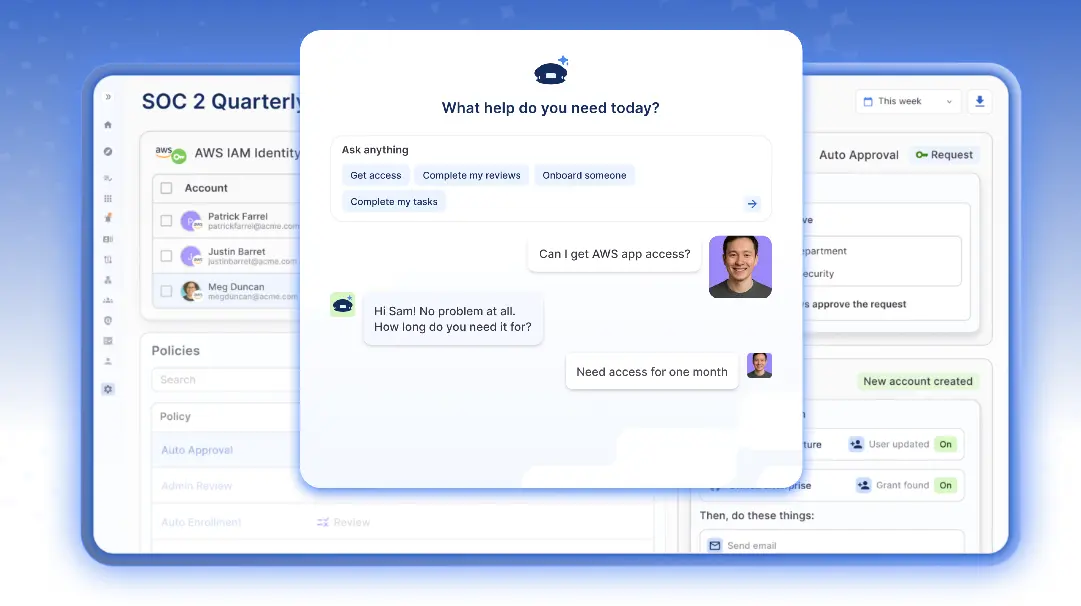
ConductorOne bridges the gap between IAM and IGA, offering a modern, AI-native approach to identity governance with automation that scales.
- Unified visibility: ConductorOne integrates with your IAM solutions (like Okta and Active Directory) and your broader infrastructure to discover all user access—including shadow accounts and direct assignments that SSO misses.
- Automated governance: Eliminate the spreadsheet chase. Run access certification campaigns that automatically notify reviewers and revoke access when denials occur, ensuring you always meet compliance requirements.
- Zero standing privileges: Move toward a zero trust architecture by implementing JIT workflows. Allow users to request temporary access to cloud-based resources and sensitive data, ensuring that permissions exist only when needed.
Book a demo with ConductorOne to see how modern IGA can strengthen your security posture without slowing down your business.


