


For the past decade, the primary headaches in identity governance and administration (IGA) were operational: slow onboarding, tedious spreadsheets, and clunky legacy software. While these friction points remain, the threat landscape has fundamentally changed.
Today, security leaders face a triple threat that legacy tools were never designed to handle:
- Explosion of autonomous AI agents,
- Rapid proliferation of non-human machine identities
- Fragmentation of access across hybrid cloud environments.
The old model of checkbox compliance—where passing an audit was the only goal—is no longer sufficient. Security risks have moved faster than governance programs, leaving organizations with massive visibility gaps.
To regain control, IT teams must pivot from managing manual processes to orchestrating scalable strategies that secure the entire identity lifecycle, from human employees to API bots.
Below, we break down the five most critical challenges facing modern IGA programs and the strategic fixes required to solve them.
1. The explosion of non-human identities (NHI) and AI
Non-human identities—such as APIs, service accounts, and bots—are growing at a rate of 43:1 compared to human identities. Traditional IGA solutions, designed for human speed, struggle to manage autonomous agents that operate at machine speed.
This creates a dangerous human-machine blur. As employees delegate authority to AI agents, it becomes difficult to attribute actions. Who—or what—is actually making decisions?
Furthermore, AI agents often operate with privileged access that exceeds that of their human creators. Protocols like the Model Context Protocol (MCP) allow machines to connect directly to data sources without intermediaries, turning these connections into high-value targets for attackers.
How to fix: Unified governance for all identity types
Organizations must stop managing non-human identities in silos.
- Unified visibility: Adopt a unified platform (like ConductorOne) that governs human and machine identities side-by-side.
- Risk parity: Apply the same zero trust rigor to bots as you do to humans. This includes enforcing lifecycle management, assigning clear ownership to every service account, and rotating credentials regularly.
- Agentic policies: Develop specific access control policies for AI agents that limit their scope, preventing them from hallucinating their way into sensitive data.
Related reading → Managing Non-Human Identity Risk in 2025
2. Data quality and identity sprawl
Effective governance relies on accurate data, yet poor data hygiene remains a persistent failure point. Governance platforms cannot make intelligent decisions if the source data is unreliable or inconsistent. Organizations often attempt to ingest data from various authoritative sources (like HR systems) without cleaning it first, which inevitably leads to misassigned access and over-permissioning.
This issue is compounded by the rapid expansion of cloud and SaaS applications. As organizations adopt multicloud strategies, data silos emerge where inconsistent policies are applied. This fragmentation makes it difficult to maintain a centralized view of security, frequently leading to ghost accounts and orphaned access across hybrid environments.
How to fix: Proactive data hygiene and centralization
You cannot automate security on top of broken data. Organizations must prioritize data cleanup as a foundational step.
- Single source of truth: Establish a centralized data lake that aggregates identity data from all sources—HRIS, directories, and applications—to create a unified view of every user and entitlement.
- Clean before automating: Remediation must happen before policy enforcement. Resolve identity conflicts and standardize attributes (like department or location) to prevent automating errors at scale.
- Unify silos: Connect disconnected applications and legacy infrastructure into the same governance model to eliminate the visibility gaps where security risks often hide.
3. Strategic misalignment and audit-driven governance
Many governance initiatives fail because they are treated as isolated IT projects rather than business strategies. When IT teams operate without business buy-in, they lack the organizational context to make effective decisions. This leads to rubber-stamping, where managers blindly approve access requests just to clear their queues.
This audit-driven mindset prioritizes passing inspections over reducing actual risk. Organizations may technically satisfy regulatory compliance, yet still leave massive security gaps—such as former contractors retaining access—because the focus was on the paperwork rather than the security posture.
How to fix: Shift accountability to the business
Governance must be reframed from a back-office IT task to a shared business responsibility.
- Business ownership: Shift accountability from IT to the application owners who understand the context. Assign clear owners for every resource to ensure access rights are reviewed by the right people.
- Risk-first focus: Communicate value in terms of risk reduction, not just compliance. The goal is to close security risks, not just close tickets.
- Contextual reviews: Empower decision-makers with data. Providing usage insights (e.g., “Last login: 6 months ago”) helps managers make informed decisions rather than guessing.
Case study → Learn how Zscaler automated access, accelerated onboarding, and simplified compliance
- Zscaler cut new hire provisioning time from weeks to just 10 minutes by implementing automated RBAC rules and Okta incremental syncs, saving 156 hours in engineering provisioning time.
- By integrating approximately 250 applications into ConductorOne’s centralized platform, the company reduced help desk access provisioning tickets by 60%.
- Zscaler reduced user access review volume by 35% by focusing on exceptions, allowing auditors to view real-time evidence of approvals and training completion without manual spreadsheets.
“The day a new hire joins, the RBAC rules kick in and they get all the access they need within 10 minutes.” — Dheeraj Malik, Director of Corporate Applications, Zscaler
4. Operational inefficiencies and manual processes
Despite the availability of automation, many organizations remain bound by inefficient legacy practices. Reliance on spreadsheets to track entitlements or document policies is prone to human error and lacks real-time visibility.
This inefficiency often extends to role design. Organizations frequently fall into role engineering paralysis, spending years trying to build a perfect role-based access control (RBAC) model. This often results in overly granular roles that are impossible to maintain, forcing teams back into manual processes for every exception.
How to fix: Intelligent automation and simplified roles
Modernize operations by replacing manual busywork with intelligent workflows.
- Eliminate spreadsheets: Move policy tracking into a dynamic IGA platform that provides a live view of user access across the organization.
- Automate provisioning: Replace manual ticketing with automated workflows for user provisioning. Ensure access is granted instantly based on policy, improving the user experience.
- Simplify roles: Avoid the trap of perfection. Focus on broad birthright access for the majority of users and handle exceptions through automated access requests rather than complex static roles.
5. Implementation and lifecycle management failures
A common pitfall is the belief that standard software won’t work because your processes are unique. This leads to over-customization of IGA systems, resulting in fragile environments that are expensive to maintain and difficult to upgrade.
Additionally, basic lifecycle management often fails at the edges. When employees leave or change roles, deprovisioning is frequently delayed due to broken integrations or lack of oversight.
This Leaver gap is a primary cause of unauthorized access and data breaches.
How to fix: Standardize and automate Joiner-Mover-Leaver (JML) workflows
Success comes from standardizing processes and automating the core Joiner-Mover-Leaver (JML) cycle.
- Standardize first: Adapt internal processes to fit modern best practices rather than customizing the software. This ensures your roadmap remains scalable and updatable.
- Automated offboarding: Implement kill switches that trigger immediate revocation of access across all cloud-based environments and on-premises systems the moment an employee is terminated.
- Phased rollout: Start by securing critical apps and authoritative sources to demonstrate value quickly before expanding to the rest of the ecosystem.
Overcome IGA challenges with ConductorOne
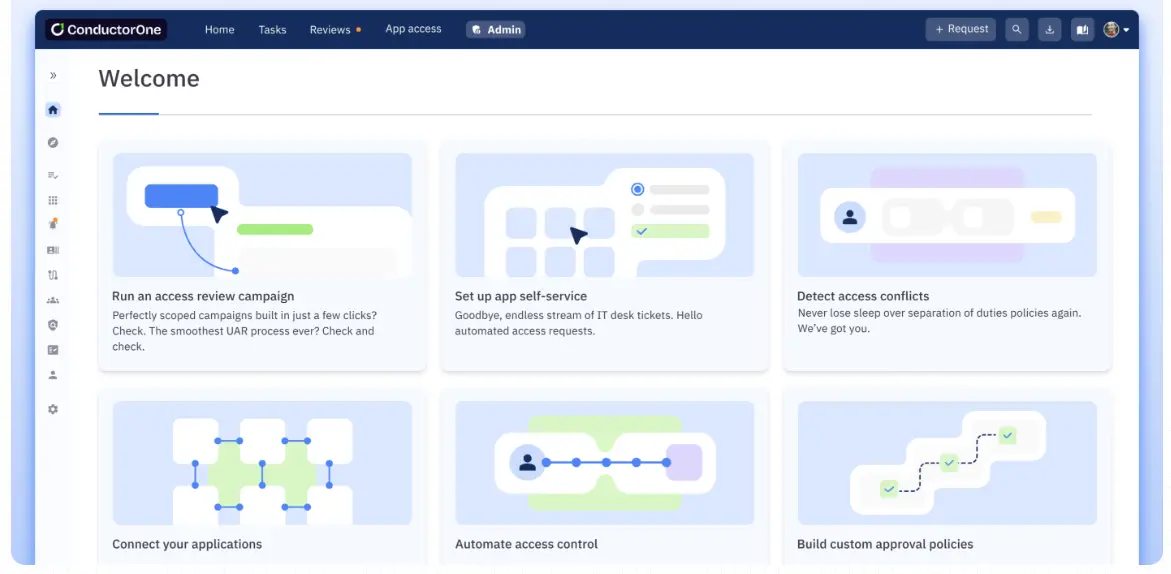
Addressing modern identity challenges—from the explosion of AI agents to the sprawl of SaaS apps—requires more than just a tool update; it requires a platform shift.
ConductorOne is an AI-native IGA platform built to secure every identity, human and machine, continuously and at scale. By replacing fragmented silos with a Unified Identity Graph, ConductorOne provides a single, queryable source of truth for your entire ecosystem.
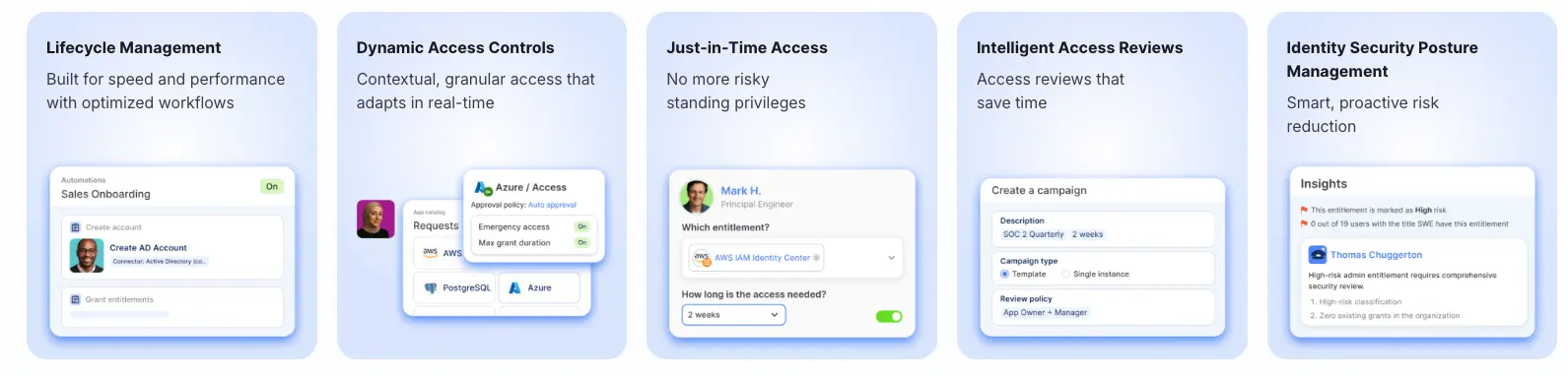
Here is how ConductorOne solves the core challenges of modern governance:
- Unified visibility: Eliminate the human-machine blur. Secure human, non-human, and AI identities on a single intelligent platform, ensuring no ghost accounts slip through the cracks.
- Automated lifecycle management: Close the JML gap. Automate onboarding and offboarding workflows to grant frictionless least privilege instantly and revoke access the moment it’s no longer needed.
- Contextual access reviews: Stop the rubber stamping. Empower business owners with real-time usage data and intelligent insights, making compliance routine and effective.
- Always-on risk remediation: Proactively find and fix orphaned accounts, unrotated credentials, and access anomalies before they become breaches.
Don’t let legacy tools hold your security back. Book a demo to see how ConductorOne can modernize your governance strategy today.
FAQs
Why are non-human identities a major challenge for modern cybersecurity?
Unlike human user identities, digital identities (such as bots and APIs) often lack robust authentication controls and scale rapidly. Without proper oversight, they can accumulate high-level permissions, becoming prime targets for attackers if not managed with the same rigor as human employees.
How does IGA help meet strict regulations like GDPR and HIPAA?
Regulations like GDPR and HIPAA require more than just intent; they require proof. Modern IGA generates immutable audit trails that demonstrate exactly who has access to sensitive data. This allows organizations to move beyond basic IAM solutions and implement proactive security measures that satisfy auditors and reduce real-world risk.
How should organizations handle access for AI agents and temporary workloads?
To prevent access sprawl, organizations should enforce on-demand access models. Instead of granting permanent standing access, modern identity security principles dictate that both human and machine users should receive temporary access management rights only when needed, reducing the blast radius of a potential breach.
What role does data quality play in effective IAM?
Data quality is the foundation of automation. If your IAM source data is messy, your governance policies will fail. Clean, centralized data ensures that user identities are mapped correctly, preventing security gaps where users might retain access after leaving the organization.

